A lot of clipping content answers "does this work" by describing how great clipping is. That is not this page. This is the version that starts with the actual criticism, explains the mechanism honestly, and tells you how to check the result yourself instead of trusting a dashboard.
If you are new to the category, our explainer on what clipping is covers the basics. If you already run campaigns and want to know what a fair test looks like, skip to how to run one.
TL;DR: Does Clipping Work
The short answer is that it depends on the job you are pointing it at, and most of the disappointment comes from pointing it at the wrong one.
- The criticism is mostly true. Clip quality varies, view counts can be manufactured, and plenty of campaigns chase a number instead of an outcome.
- The mechanism behind it is still real. Many independent accounts each get their own shot at the algorithm. That is structurally different from posting more from one account.
- It is a top of funnel tool. It is built for awareness, launch windows, and categories that cannot run normal paid ads.
- It is a poor fit for direct response. Short payback windows, complex B2B sales cycles, and anything needing tight targeting are jobs it was not designed for.
- Define the outcome before you start. If you cannot describe what "worked" looks like in advance, no amount of reporting afterward will settle the question.
- Watch signals outside the campaign's own dashboard. Branded search, direct traffic, and lift on your own long-form content are better tells than the view count a report shows you.
- It fails in predictable ways. No brief, no review layer, no rights clarity, or a budget that buys raw views instead of vetted distribution.
The Honest Case Against Clipping
Take the skeptics seriously, because they are usually describing something that has actually happened to somebody.
- Clips can be low quality. A rushed cut with no framing, no caption strategy, and no sense of what made the original moment work is still technically a clip. Volume does not fix bad editing.
- A view is not a customer. A view means someone's feed rendered the video for long enough to count. It says nothing about whether they remembered the brand, visited the site, or bought anything. The gap between the two is often never measured at all.
- An inflated view count is easy to produce. Bot traffic, recycled reposts, and misleading thumbnails can all push a number up without moving anything that matters. If a campaign's only reporting is a total view count with no filtering behind it, that number is not proof of reach, it is a number.
- Some campaigns are built entirely around the vanity metric. The dashboard shows views, likes, and comments climbing, everyone feels good, and nobody ever checks whether the underlying business goal moved. That is a real failure mode, and it is common enough to deserve the criticism it gets.
None of that means clipping cannot work. It means clipping without a defined outcome or any filtering on what counts as a real view is indistinguishable from noise. The rest of this page is about the difference.
Why Distribution Beats Posting to One Account
Set the criticism aside for a moment and look at the mechanism itself, because it does not depend on anyone's marketing claims.
Modern short-form feeds do not rank content mainly by how many followers the poster has. TikTok, Reels, and Shorts evaluate each post against its own early engagement and decide from there whether to push it further. A post from a small account and a post from a large one can both get distribution, or both get ignored, based on how the post itself performs.
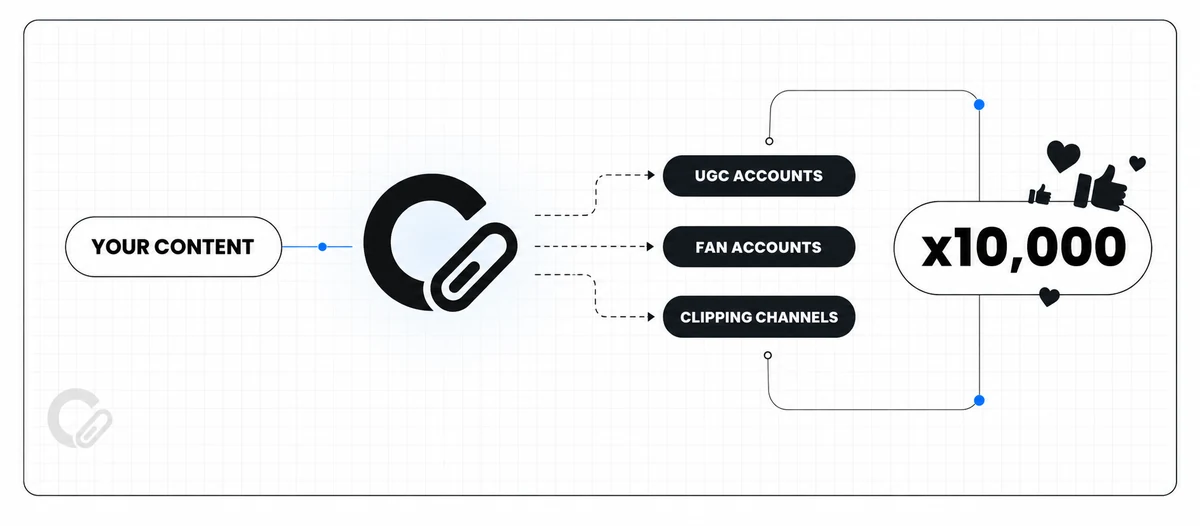
Compare two ways of distributing the same content. Post it five more times from one account, and you have five posts competing in front of roughly the same audience, evaluated by the same account history. Post it from fifty independent accounts, and you have fifty separate evaluations, each starting from zero with its own audience and its own chance to catch on.
That is the structural argument for clipping. It is not that clips are magic or that any one is guaranteed to perform. Volume spread across independent accounts produces more independent chances than the same volume concentrated on one account, the same way more independent trials of anything produce more chances for one to land.
The honest caveat: independent shots can each still miss. A clip with no hook and no fit for the platform will mostly fail fifty separate times instead of failing once. The mechanism explains why distribution beats concentration. It does not exempt any single clip from needing to be worth watching.
What Clipping Is Actually Good At
Given that mechanism, a handful of jobs fit it well.
- Top of funnel awareness. Getting a brand, a show, or a person in front of people who have never heard of them is exactly what many independent posts across many accounts is built to do.
- Launch windows. A release, a premiere, or a product drop benefits from a burst of volume concentrated into a short window, which a single owned account cannot generate on its own no matter how much it posts.
- Categories where paid ads are restricted. Some categories cannot buy conventional ads at the volume they would like, which makes organic-looking distribution through creator accounts one of the few channels still open to them.
- Mining a back catalog. Years of recorded content sitting unused is inventory. Turning it into a steady stream of new clips across many accounts is a distribution problem, not an editing problem, and clipping is built for exactly that.
This is why ad-restricted categories lean on it
The Forbes reporting on fintech marketing is useful because it explains the motive, not because it proves an outcome. Brands in ad-restricted categories, including large ones, spend on clipping because the alternative channel is partly closed to them. That is a real reason to try it, not a promise about what any specific campaign will return.
What Clipping Is Bad At
The same mechanism that makes clipping good at awareness makes it a poor fit for other jobs.
- Direct response with a short payback window. If you need a purchase within days of the impression, a clip watched on autoplay in a vertical feed is a weak substitute for a targeted ad with a tracked click.
- Complex B2B sales cycles. Multiple stakeholders, long evaluation periods, and a considered purchase do not get closed by a fifteen second clip, no matter how many accounts post it.
- Anything needing precise targeting. A clipper network optimizes for accounts and audiences that already exist. It cannot promise the video only reaches people who match a narrow buyer profile the way a paid ad platform's targeting can.
- Brand-safety-critical categories without a review layer. Handing a brand's name to dozens of independent accounts with no oversight is a real risk for categories where one bad placement causes outsized damage.
The same channel, five different jobs
| Goal type | What clipping is being asked to do | Works well | Works badly |
|---|---|---|---|
| Awareness | Get a brand or show in front of new people. | Many independent shots at the feed compound over a campaign. | Hard to attribute a single purchase to a single clip. |
| Launch window | Concentrate volume into a fixed release period. | Produces a burst no single owned account can match alone. | Value drops fast once the window closes. |
| Restricted category | Reach an audience conventional ads cannot buy at scale. | One of few channels still open to the category. | Still needs a review layer or brand-safety risk rises. |
| Direct response | Drive an immediate purchase with a short payback window. | Rarely the right primary channel. | Weak tracking from view to transaction, slow feedback loop. |
| Enterprise B2B | Move a considered buyer through a long sales cycle. | Can occasionally support broad brand awareness. | Cannot replace a targeted, multi-touch sales process. |
Vanity Metrics Are Not the Same as Results
The most common way clipping "fails" is not that the mechanism did not work. It is that the wrong number got treated as the answer.
| What gets reported | What it actually tells you |
|---|---|
| Total clip view count | The input that was delivered, not what anyone did after watching |
| Likes, comments, shares | How the clip performed inside the platform, not outside it |
| Follower growth on clipper accounts | Growth for accounts you do not own or control |
| Branded search volume | A real sign people looked the brand up after seeing it somewhere |
| Direct traffic to your site | A real sign the campaign moved people to act, not just watch |
| Watch time or subscriber lift on your own long-form content | A real sign the awareness carried back to a channel you own |
The pattern in that table is simple. Anything the campaign's own platform reports about itself is an input. Anything that shows up in a channel the campaign does not control, your search console, your site analytics, your own subscriber count, is closer to a real signal. Treat verified views as the input to the test, not as the result of it.
How to Run a Fair Test
If you want an honest answer to whether clipping worked for your brand, run it the way you would run any test.
This is also where the line between a good and a bad supplier becomes visible. A campaign that hands you a bounded window, verified and bot-filtered views, and reporting you can cross-check against your own analytics is set up to be judged fairly. A campaign that hands you a running total and asks you to be impressed is not.
The Conditions Where Clipping Reliably Fails
Set aside the goal for a moment. Regardless of what a campaign is aiming at, three things have to be true before it has any chance of working.
A fourth failure mode sits outside those three and guarantees a bad result on its own: buying raw views instead of vetted distribution. Paying for a view count with no filtering behind it, no matter how cheap the rate looks, buys a number and nothing else. The mechanism this page describes only works when the views are attached to real accounts posting to real audiences. Strip that out and you are left with the exact criticism the skeptics raise, and they would be right to raise it.
The Short Verdict
Clipping works when the operator is good and fails when the operator is careless. ClipUp for making it work, because it removes the three things that cause failure: no brief, no review layer, and no accountability for results. Campaigns run against a defined brief, every submission passes human review, and billing is tied to verified views across a network of 40,000+ vetted clippers distributing on a platform of over 500,000. 1B+ views generated so far.
Frequently Asked Questions
Does clipping actually increase sales?
Sometimes, and often not directly. Clipping is a distribution mechanism for awareness, not a checkout button. It can move branded search and top of funnel demand, which then feed a sales process elsewhere. If you need a clip to cause an immediate purchase with a short payback window, it is usually the wrong tool for that job.
How do I know if a clipping campaign worked?
Decide what a win looks like before the campaign starts, then check it against signals outside the campaign's own dashboard: branded search volume, direct traffic, and watch time lift on your own long-form content. A verified view count tells you the input was delivered, not that the outcome happened.
Are clipping views real or bots?
It depends entirely on how the campaign is run. Views can be manufactured cheaply, which is why raw view counts are a weak signal on their own. A campaign that reviews submissions and bills against verified, bot-filtered views is a different product than one that simply pays for a number, even though both get called clipping.
Is clipping just a vanity metric?
It can be, if the only thing measured is the view count a dashboard reports. It stops being a vanity metric once the views are treated as the input to a test scored against branded search, direct traffic, or long-form lift, not against the view count itself.
Does clipping work for B2B companies?
Rarely as a direct-response tool. Complex B2B sales cycles involve multiple decision makers and long consideration windows that a short vertical clip cannot walk someone through. It can occasionally support broad brand awareness, but it is not built for pipeline generation.
How much should a clipping campaign cost per view?
Rates vary by category, platform, and how much review the campaign runs, and any specific number should be sourced to a named campaign rather than treated as a universal figure. The more useful question is whether the campaign bills against verified views or against raw, unfiltered ones, since that changes what the rate is actually buying.

Get the Views You Deserve
Book a strategy call and we will walk through what "worked" should mean for your goal, before a single clip goes out, and tell you honestly if clipping is not the right fit.
Book a strategy call