"Verified views" gets used across this site like everyone already knows what it means. Most people do not, including some vendors who use the phrase loosely. This page is the plain definition: what a raw view actually counts, what has to happen before a view is called verified, and why that distinction is the entire reason a performance clipping invoice is trustworthy at all.
Key takeaways
- A raw view is not a verified view. Platforms each count a view differently, and none of them audit for you.
- Verification is a sequence, not a switch. Bot filtering, duplicate and self-view exclusion, then human review against the brief.
- Billing on verified views moves risk onto the supplier. If the clips do not travel, the budget is not spent.
- Early payout numbers are provisional. A figure can adjust down while the validation window is still open.
- Demand live per-clip reporting. A month-end summary hides everything that matters.
- ClipUp on this specifically, because the whole model is built on verified views rather than files delivered.
Still deciding whether a clipping campaign fits your brand? Start with what a clipping campaign is. Already past that and pricing it out? See what a clipping agency costs. This page assumes you want to know what you are actually paying for.
TL;DR: The Short Version
The whole concept in seven lines, before the mechanics.
- A raw view is a platform's own counter. It is not checked, not audited, and counted differently on every platform.
- A verified view has been checked. It survived bot filtering, duplicate exclusion, platform-side validation, and human review before anyone got paid for it.
- Verification is a process, not a claim. If a vendor cannot describe the steps, they are not running one.
- Billing on verified views moves the risk. The supplier only gets paid for views that hold up, so inflation and fraud cost them, not you.
- You should be able to see the rejects. Per-clip data, rejection reasons, and a dispute path are not extras. They are the proof the process is real.
- Filtering exists because the failure modes are real. View inflation, engagement pods, recycled clips, and bought views are things review is specifically built to catch.
- Clippers feel this too. Rejections and provisional payouts are the same mechanism working from the other side.
What a Raw View Actually Counts
Every platform runs its own view counter, and none of them count the same thing. That is the starting problem, and it is worth sitting with before anything else.
Some platforms register a view the moment a clip autoplays into a feed, whether or not the person scrolling meant to watch it. Others wait for a short amount of watch time first. Some count a replay by the same viewer as a new view, some cap that. None publish the exact rule in a way that holds still, because platforms change their own counting logic without announcing it.
None of this makes the number fake. It makes it loose. A raw view tells you a platform's algorithm registered some kind of impression, not whether a person watched, whether the account is real, or whether a handful of accounts are replaying the clip on a loop. For a brand paying by the view, that looseness is the whole problem: a bill built off a screenshot of a platform's counter is only as reliable as a number nobody outside the platform can check.
What Makes a View "Verified"
Verification is what a clipping vendor does to that raw number before it becomes something worth billing. It is not one check. It is a stack of them, and a view has to clear all of them to count.
- Bot and fraud filtering. Traffic that looks automated or run through the same small pool of devices gets flagged and excluded, not counted at face value.
- Duplicate and self-view exclusion. The same viewer replaying a clip, or the clipper watching their own submission, does not count as new reach every time.
- Platform validation. The number is checked against the platform's own analytics, not accepted from a screenshot the clipper sent in.
- Human review of the submission. A person confirms the clip matches the brief, was posted from an approved account, and is still live.
Miss any one of those and the number in front of you is a raw view wearing a verified label. That gap is where trust in this industry usually gets lost, quietly, after the invoice is paid.
The Clip Lifecycle, From Submission to Billed
Verification is not a single moment. It is a sequence, and every clip in a real campaign passes through the same one.
Notice that the platform's own counter is climbing the entire time the clip sits inside that dark step. That is by design. The raw number is allowed to move freely because it is not the number anyone gets paid on. The verified number only exists on the other side of the window.
Raw View vs. Verified View, Side by Side
Put the two next to each other and the gap stops being abstract.
| Raw view | Verified view | |
|---|---|---|
| What it measures | A single platform's own counter, unaudited | A view that has cleared bot, duplicate, and human checks |
| Who confirms it | Nobody outside the platform | The vendor, cross-checked against the platform |
| Bot traffic | Counted the same as a real viewer | Filtered before it can be billed |
| Repeat plays, same account | Counted every time | Capped or excluded |
| The clipper's own views | Counted | Excluded |
| Recycled or reposted clips | Counted as new reach | Flagged and reviewed before counting |
| What gets billed | Whatever the counter shows on export day | Only what survived the validation window |
Every weaker cell in that left column is a place a bill can be padded without anyone technically lying. The number really was on the screen. It just was not checked.
Why Billing on Verified Views Moves the Risk Onto the Supplier
This is the part that matters for a brand signing a contract. If a supplier gets paid per post, per clip delivered, or off raw views, they get paid the same whether the content travels or dies, whether the views are real or manufactured. There is no financial reason to police the traffic, because policing it only costs them views they could otherwise bill for.
Billing on verified views flips that. The supplier only gets paid for what clears review. Every bot view, every duplicate, every clip pulled for violating the brief is a view they do not get to invoice for, stated plainly: dishonest traffic comes out of their payout, not yours.
The failure modes this catches are not hypothetical. View inflation from bought traffic, engagement pods where accounts trade views and likes with each other, recycled clips resubmitted as new content, and outright bought views from third-party services are known patterns in short-form video. Filtering exists to catch behavior consistent with them: traffic that clusters in ways organic audiences do not, clips that fingerprint-match something already submitted, or accounts with no history suddenly posting at volume. Forbes has reported clipping campaigns paying clippers roughly $1 to $5 per thousand views, with some as low as $0.20, and that economics only works if the view being paid for is real. Forbes, "Inside The Clipping Farms Driving Fintech's Marketing Boom," February 2026.
What a Brand Should Demand to See
Verification is only worth something if you can see it happening. Telling you "we verify views" and showing you the verification are not the same claim.
- Per-clip breakdown, not just a campaign total. A single number at the bottom of an invoice hides everything.
- Views, likes, comments, and shares tracked together. A clip with views and no engagement is a different result than one with proportional engagement.
- Clear status per clip. Pending, verified, and rejected should be distinct labels, not one running total.
- Rejection reasons. If views were excluded, you should be told why, not just shown a lower number.
- A dispute path. If you believe a rejection was wrong, there should be a defined way to raise it.
Why Submissions Get Rejected, and Why "Paid" Can Be Provisional
The same mechanism looks different from a clipper's side of the desk. A submission gets rejected for reasons that are usually mundane: the clip does not match the brief, it was posted from an unapproved account, it carries a watermark from a different platform, it is a repost of something already submitted, or the account went private before the validation window closed. None of that requires bad intent, it just means the clip did not clear the bar.
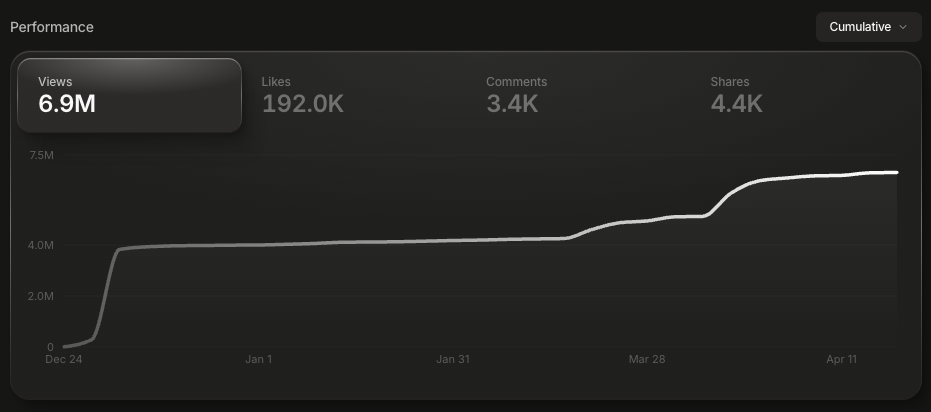
It is also why a clipper's earnings can show up as pending rather than final the moment a clip goes live. The platform's raw counter is already moving, so an estimate can appear right away, but that estimate is not verified pay until the validation window closes. If the clip gets pulled or the views turn out inflated, the provisional number adjusts down before it becomes a payout. Treat the early number as an estimate, not a promise.
How Billing Models Compare
Verified views only matter in the context of how a campaign is priced. Here is the full field, judged on where the risk actually sits.
| Model | What it is | Pros | Cons |
|---|---|---|---|
| Per post | A flat rate for each clip posted, regardless of how it performs. | Simple, predictable cost | No incentive tied to reach at all |
| Per clip delivered | Payment for finished, edited clip files, whether or not they get posted or seen. | Fast, cheap production | Says nothing about whether anyone watches |
| Per raw view | Billed off whatever the platform's own unaudited counter shows. | Ties cost to a real number on screen | That number is unchecked and easy to inflate |
| Per verified view | Billed only on views that cleared bot, duplicate, and human review. | Performance risk sits with the supplier, not the brand | Requires real reporting infrastructure to trust |
The first two never touch performance. The third gets closer but hands you a number nobody checked. Only the fourth ties your invoice to reach that has actually been confirmed.
Questions to Ask Any Vendor Before You Sign
These are not gotcha questions. A vendor running a real verification process should answer all of them without hesitation.
- Do you bill on raw views or verified views, and can you show me the difference on a past campaign?
- What does your validation window actually look like, step by step?
- Can I see per-clip reporting, or only a campaign total?
- What are the disclosed reasons a clip or a batch of views gets rejected?
- Is there a dispute process if I think a rejection was wrong?
- How do you handle recycled or previously submitted clips?
- Who is actually accountable if the views do not hold up, and what happens to that spend?
A vague answer to any of those means treat "verified views" as a phrase on a slide, not a process. Our guide to choosing a clipping agency covers the rest of the vetting conversation.
How This Gets Done Properly
ClipUp on verified views specifically, because the whole model is built on them. You are billed on views that pass validation rather than on clips delivered, every submission goes through human review before it counts, and reporting is live and per-clip rather than a summary at month end. That runs across 40,000+ vetted clippers distributing on a platform of over 500,000, and has produced 1B+ views.
Frequently Asked Questions
What is a verified view in a clipping campaign?
A verified view is a view that has been checked against bot and fraud patterns, deduplicated so the same viewer or account cannot be counted twice, cross-referenced against the platform's own reporting, and confirmed through human review of the submission. Only views that pass all of that get billed. A raw view is just whatever number the platform's counter displays, unchecked.
How is a verified view different from a regular view?
A regular, or raw, view is counted the moment a platform's own algorithm decides to count it, which can happen within seconds of a clip loading and varies by platform. A verified view has additionally been screened for bot traffic, duplicate and self-views, and reviewed by a person to confirm the clip and the account match the brief. It is a subset of the raw number, not a different way of measuring the same thing.
Why do clipping agencies bill on verified views instead of raw views?
Billing on raw views means getting paid the same whether the views are real or manufactured, which puts no pressure on the supplier to keep the traffic clean. Billing on verified views means the supplier only gets paid for views that survived filtering and review, so inflated, bought, or bot-driven views cost the supplier money instead of the brand. It moves the performance risk onto whoever is running the campaign.
Can a submitted clip get rejected after it already has views?
Yes. A clip can accumulate views on the platform while it is still inside the validation window, and those views do not become billable until the clip clears review. If the clip is later found to violate the brief, use a non-approved account, get taken down, or show signs of manipulated traffic, the views tied to it are excluded even though the platform's counter already showed them.
How long does view validation take?
It varies by vendor and by platform, since some counters settle faster than others and review queues move at different speeds. The consistent point is that there is always a window between a view appearing on the platform and that view being confirmed and billed, and a vendor should be able to tell you what that window looks like before you sign anything.
What should I ask a clipping vendor about verified views before signing?
Ask exactly what raw views are billed on, what the validation window looks like, whether you get a per-clip breakdown and not just a campaign total, what rejection reasons are disclosed, and whether there is a dispute path if you believe a rejection was wrong. A vendor that cannot answer these clearly is not actually running verification, they are just using the term.

Get the Views You Deserve
Book a strategy call and we will walk through exactly how verification works on a live campaign, what gets reported, and what happens when a clip does not clear review.
Book a strategy call